Cityscapes, landscapes, and portraits in oil and mixed media.
Work available directly from the studio. Viewings by appointment.
The city as sequential color adjacencies at walking speed. Painted from photographs taken on neighborhood walks in Manhattan.
An emerging body of work from the Rio Grande Valley of South Texas. A new Valley landscape series is in preparation for 2026–2027.
Painted from photographs and personal reference. Oil on canvas and panel.
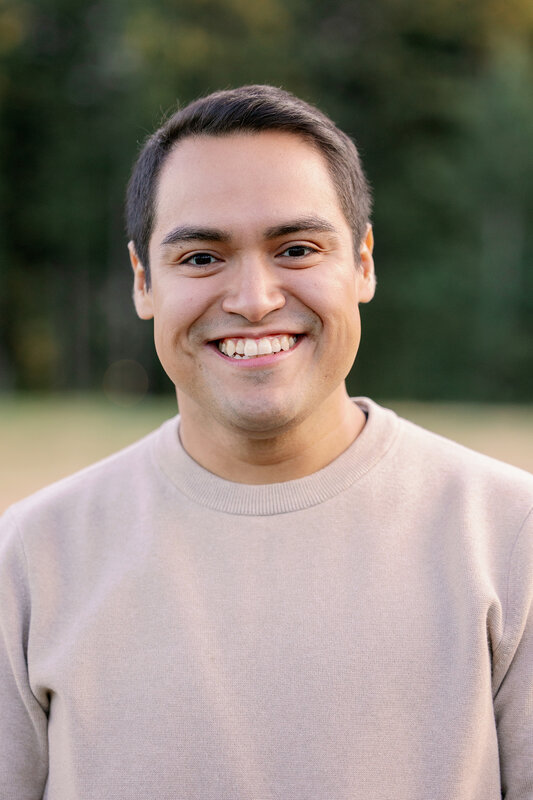
Photograph, 2024
I paint cityscapes, landscapes, and portraits. The cityscapes come out of a specific idea — that walking through a neighborhood is an experience of color read sequentially, one awning against the next wall against the next fire escape, and that a painting can hold that sequence still without flattening it into a single view. The landscapes and portraits extend the same question into different registers.
I was born in the Rio Grande Valley of South Texas and live in Yorkville, on the Upper East Side of Manhattan. I work in oil and mixed media on canvas and canvas panel. Most of the paintings begin with photographs I take on neighborhood walks or from personal reference, which I then depart from in the studio. I sign my work Adrián González Molina.
Work is available directly from the studio. Viewings by appointment in Manhattan, and inquiries about specific paintings or exhibition opportunities are welcome at [email protected].
For purchase inquiries, viewings, and exhibition opportunities.
Lex 63
The Q train platform at Lexington and 63rd, seen head-on from across the tracks. The station reads as four horizontal bands — black ceiling with its brown I-beams, a green strip of tiled wall, the pale grid of the platform face, and the red-and-white chevron that runs along the edge. A dark patch near the center is a broken tile; the grey wash running down through it is what the wall actually looks like after years of leaks.
Franklin & Church, Tribeca
Two Tribeca towers seen from the sidewalk, looking straight up. The Jenga tower rises behind a construction-phase facade, its stacked volumes rendered in pinks and greens that have nothing to do with the actual building and everything to do with what the markers and oil sticks had to offer. The orange grid in front is all heat — yellow edges boxing dark windows into a repeating pattern that fills the canvas edge to edge. At the top, faint curls of titanium white are the only soft passage, pushing the tower back into the sky.
Wrapped Building, Tribeca
A Tribeca intersection with a building under construction at the center, wrapped in scaffold-blue netting that you can see the orange brickwork through. The view looks northwest across Sixth Avenue toward White Street, with the Roxy Hotel's cast-iron sidewalk clock at the far right edge. A yellow cab cuts through the foreground, figures walk the crosswalks. The sky is built up with visible blue scribbling worked under and into the paint.
A View from Central Park
A Fifth Avenue tower at the moment late sun hits it, painted from a photograph taken on a walk near the reservoir. The orange of the building is hatched marker laid over an oil ground — short, repeated strokes that vary the warm field without breaking it. The sky is built the same way in cobalt scribble. Green oil at the bottom dissolves into loose script, white and black marks that nearly read as writing.
Mid-August Monument
A red-brick apartment building in the artist's Upper East Side neighborhood, painted from a photograph taken in mid-August 2024 from directly below. The building stretches up toward a black water tower at the roofline, and foliage from the tree the artist was standing under presses into the top edge of the canvas. The palette is the same six-color marker and oil-stick set as the rest of the series — with no brick available, the facade is pure red against black-shadowed sides. No brush was used; the sky and clouds are blended with the finger.
Halloween Morning, East 89th
A street canyon on East 89th the morning after Halloween. Orange on the left, red on the right, a sliver of blue sky between them — the reference photo gave up the composition and the painting took over from there. A ghosted tower sits at the vanishing point, drawn in wet-into-wet oil stick so the building dissolves before it resolves. The lamppost is the only hard black in the painting.
Marquee (Chelsea will you marry me)
The marquee of the Village East by Angelika at Second Avenue and 12th Street, caught on a walk home after seeing a friend. Someone had paid to put a marriage proposal on the sign — the message lit the block. The red arched facade of the old Yiddish Art Theatre sits against the blue grid of the tenement next door, and two figures cross the sidewalk below without looking up. The street is painted wet. The reference photo wasn't.
Steeple, Blue-yellow Sky
The Gothic Revival steeple of the Church of St. Thomas More on East 89th near Madison, rising past the red brick wall of the neighboring building. The sky is the title's subject — blues in multiple values, with yellow worked through the clouds — held above a yellow roof band and a blue building mass below. Black windows run up the white steeple. Green foliage wraps the upper right and the foreground.
August Night Diptych
A diptych painted from a single landscape photograph taken from inside Central Park between East Drive and the Reservoir, facing Engineers' Gate on an August evening — early enough to still have light in the sky. The left panel looks north to the Church of the Heavenly Rest at 90th and Fifth, with a red apartment building rising behind the two white-arched church gables. The right panel looks south to 1080 Fifth Avenue, with a park lamppost curving over the street in black. The sky runs continuously across both canvases: pale blue worked with yellow streaks, late summer light turning toward evening.
Salon 94 on 89th
Salon 94's facade on East 89th Street, painted from a walk in the neighborhood. The palette is dictated by the materials — six paint markers and six oil sticks in red, yellow, blue, white, black, and green. The actual building is tan limestone; here it is the warmest object in the picture. Two parked cars sit on the slope of the street.
Cityscape No. 1
The buildings lean and overlap like trees in a thicket — the prompt that started this work was to paint a city as a forest. Charcoal does most of the structural work, framing each form before the oil stick goes down. White dots stand in for windows. Behind the roofline, yellow reads as sky. The first painting in the cityscape series.
Jackson Road, Pharr, Texas
An abandoned roadside store on Jackson Road in Pharr, Texas, painted from a photo taken from the car on a drive with the artist's parents. Deep blue wall, a yellow patch where something has fallen away, weathered lettering on a corrugated panel — none of it legible anymore. Power lines sweep across the full width of the sky and hold the composition together. Below, a stretch of unpaved ground — pink and salmon where the clay subsoil shows through — cuts between the building and a wild green foreground of grass.
At Lunch in LA
A woman in an orange jacket leans forward, middle finger up against her cheek, grinning. The gesture is the first thing you see. Her braids have lighter highlights at the crown; behind her, a flat olive-dark ground gives the orange nowhere to go but forward. Charcoal lines hold the hands and arms together where the paint thins out, and a triangle of bare canvas near the bottom stays unpainted — the painting was finished before anyone noticed.
After Manu Rios
A portrait of the Spanish actor and model Manu Rios, painted from a screenshot of his Instagram story. He wears wraparound black sunglasses and a thin chain with a small dark pendant, shirtless against a pale wall with a palm or pine pushing in from the upper right. The face is fully resolved — the mouth in deep plum, the stubble, the small ear, the flick of light on the bridge of the nose — while the shoulders and chest fall off into loose wet brushwork.
After Manu Rios II
A second portrait of the Spanish actor and model Manu Rios, painted from a screenshot of his Instagram story. Head and shoulders, three-quarter view, head tilted slightly down but eyes on the camera. A black stylist's or barber's cape is draped over his shoulders, set against a background of four flat color blocks — lavender-grey sky, a yellow panel at left, two browns behind. The face is resolved edge-to-edge: heavy-lidded grey-blue eyes, a dark mustache, full pink mouth, two small moles low on the right cheek.
A Woman Seated (My Tía Boro)
A woman in a black-and-white dress scattered with pink and lavender florals sits on a wooden chair. Her hair is a close cap of white, her face painted in oranges, and the figure holds together at the top before coming apart toward the bottom — florals break into strokes, the legs thin out. On the right, light from an off-canvas lamp falls in a long downward curtain, and a patch of dark blue sits at her side like a lumped piece of cloth.
Snickers' 10th Birthday
A portrait of Snickers, a salt-and-pepper terrier mix, on the evening of his tenth birthday. He's wearing a blue pinstripe coat with white trim. A small round cake sits in a deep dish with curved edges on a white plate in front of him, his name piped across the front in orange frosting; candles rise from the top in yellow, green, red, and blue. The candle flames catch the underside of his muzzle and cast orange-cream light up into the whole front of his body — the painting renders him entirely in fire-warmed color. None of his actual gray coat is visible. The candle light is the stronger truth.
31 Stars (For California)
The layout quotes the 31-star flag adopted in 1851 when California became a state — seven, five, six, six, seven — one of the justified-row patterns used before the star arrangement was standardized. The painting was made in June 2025 during the anti-ICE protests in Los Angeles. The grid held for the artist as the aerial view of a protest clash — stars holding position on a field, bodies in a square. Conté underneath, oil on top, red stripes run wet across the blue.